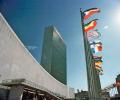
On October 24, the United Nations turns 70. 'The credibility of the UN has been eroded by the fact that the Security Council does not represent the political realities of the world today,' says Ambassador T P Sreenivasan, listing the 10 things the UN needs to do to become more relevant and effective.
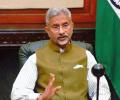
External Affairs Minister S Jaishankar will arrive in New York on Sunday to participate in the high-level 77th session of the UN General Assembly, which kicks off on September 20 with the opening of the general debate.

The UN General Assembly on Monday adopted a negotiating text by consensus for the long-pending Security Council reforms, setting the stage for talks on the issue at its 70th session beginning on Tuesday, boosting India's bid for a permanent seat in the revamped world body.

The Security Council as it is today is unable to bring peace and security in the world and so there is reason for countries like India to become members of the Council, Ambassador Asoke Kumar Mukerji tells Sheela Bhatt/Rediff.com.
India proposes to organise a briefing of the Security Council on December 15 on 'Global counter-terrorism approach - principles and the way forward" under the 'Threats to international peace and security caused by terrorist acts'.

"Will the President, while he is in India and probably while he is speaking to the Parliament, utter the words, 'The United States supports India's permanent membership in a reformed UN Security Council' or not?

"The responsibilities of member states must be assumed by member states and let's not make the UN the scapegoat of the failures or of the negative actions that are committed by member states," he said.
Determined to continue their efforts for reforms in the United Nations, India, Brazil and South Africa have called for "immediate, element-based and result-oriented" inter-governmental negotiations for the expansion of Security Council.

PM Modi went to New York this time not to engage in polemics, but to find solutions to global problems. He made some progress on several matters, even on reform of the UN Security Council, when the US made a major concession for the first time that six permanent members without veto, including India, could be considered
"We have a strong view that there should be Security Council reform of the United Nations, that the Security Council should reflect the modern world, which is why we've suggested that both India and Japan should become permanent members of a reformed United Nations Security Council," the Australian foreign minister said.
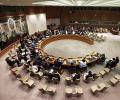
The United Kingdom, France and Nepal have supported India's candidature as a permanent member of a reformed United Nations Security Council as member nations expressed frustration at the lack of progress on long-pending reforms in the powerful UN body.

First Secretary in the Permanent Mission of India to the UN called Pakistan a 'hub of terrorism'.
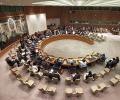
China is a permanent member of the UNSC while India began its two-year tenure as a non-permanent member on January 1.
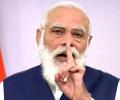
In his pre-recorded video statement to the landmark General Debate of the 75th session of the United Nations General Assembly, Modi said the stability in the United Nations and empowerment of the world body are essential for the welfare of the world.

Noting that the last reforms to the Security Council were made in the sixties, Ambassador of France to India Jerome Bonnafont said "if we want the Security Council to remain a legitimate place for handling peace and security crisis in the world, it is absolutely necessary to have India as well as couple of others as permanent members."
Criticising the G-4 proposals, Pakistani UN Ambassador Munir Akram said a vote on it should be avoided as it would 'divide the membership and raise tensions in different parts of the world'.
The US welcomed the election of India as a non-permanent member of the powerful UN Security Council along with South Africa and Brazil and hoped these countries would play an important and constructive role in resolving key global issues together.
India will push hard for an early implementation of comprehensive reform of the United Nations Security Council and expansion in its membership when inter-governmental negotiations on the issue begin in New York on Thursday.

Ahead of Prime Minister Narendra Modi's visit to the United States, External Affairs Minister Sushma Swaraj held bilateral meetings with foreign ministers of seven countries, including the United Kingdom, on the sidelines of the 69th session of the United Nations General Assembly on Wednesday.
Prime Minister Narendra Modi has acknowledged that the dreaded terror group Islamic State poses one of the greatest challenges facing the international community today and said there is a need to "delink terrorism from religion".

'...to bring the Global South and others to the negotiating table on the basis of Gandhi's non-violence so that we can leave a safer world for our children.'

India has criticised the UN over lack of any 'specific concrete action' by member states to penalise those who attack.
Libyan leader Muammar Gadhafi has opposed the expansion of the United Nations Security Council by including countries like India which would spur a 'competition' with nations like Pakistan wanting to get in.
New Delhi's candidature was unanimously endorsed by the 55-member Asia-Pacific grouping, including China and Pakistan, in June last year.

President Donald Trump signed an executive order withdrawing the US from the UN Human Rights Council and prohibiting any future funding for the UN agency for Palestinian refugees. Trump also directed the US to review its participation in UNESCO, citing concerns about anti-Semitism and anti-Israel sentiment within the organizations. The executive order argues that the UNHRC, UNESCO, and UNRWA have drifted from their missions and act contrary to US interests. Trump previously halted funds for UNRWA during his first term, and President Joe Biden put a block on US funds for UNRWA in January 2024 over allegations that staff for the agency participated in Hamas's October 7, 2023, attack against Israel.
India and Africa on Wednesday declared their support to each other for a permanent seat in the expanded United Nations Security Council and favoured reforms of the world body to make it more representative and democratic.

External affairs minister S Jaishankar on Tuesday discussed issues relating to Afghanistan and the Indo-Pacific during his bilateral meetings with global counterparts on the sidelines of the annual high-level UN General Assembly session.

India on Thursday (local time) wrapped up its December Presidency of the United Nations Security Council with a special focus on terrorism, Global South and maritime security.

What are India's chances of getting a permanent seat in a revamped UN Security Council?

A statement issued by the Pakistan mission claimed that Lodhi last week "exposed" the G-4 position on Security Council expansion.
India, Japan, Germany and Brazil, collectively called Group of Four (G-4), are strong candidates for permanent seats in an expanded Council.

Prime Minister Narendra Modi on Sunday made a fresh push for reforms in global institutions, including the United Nations, asserting that the world's 'new realities' should be reflected in 'new global structure' as it is nature's law that those who don't change with times lose their relevance.

The leaders also noted the "negative impacts" of the war in Ukraine with regard to global food and energy security, especially for developing and least-developed countries.
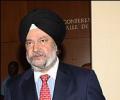
More than a decade after India launched a spirited campaign for a United Nations Comprehensive Convention on International Terrorism as well as reform of the UN Security Council, both in the permanent and non-permanent categories, there is renewed hope that both campaigns may succeed, thanks to India's untiring diplomatic efforts at the world body. Ambassador Hardeep Singh Puri.

India's permanent membership in the reformed UNSC is unacceptable to Pakistan

'Kofi Annan will be remembered more for his Nobel Prize and related glory rather than Rwanda and Volcker,' notes Ambassador T P Sreenivasan with whom he worked in the UN.
Britain has backed India for a permanent seat in the United Nations Security Council to make the world body more credible and effective.
